What Do Digital Marketers Do? Roles, Responsibilities & 2026 Trends
If you’ve ever wondered what a digital marketer actually does between nine and five — beyond posting the occasional social media update — this guide is for you.
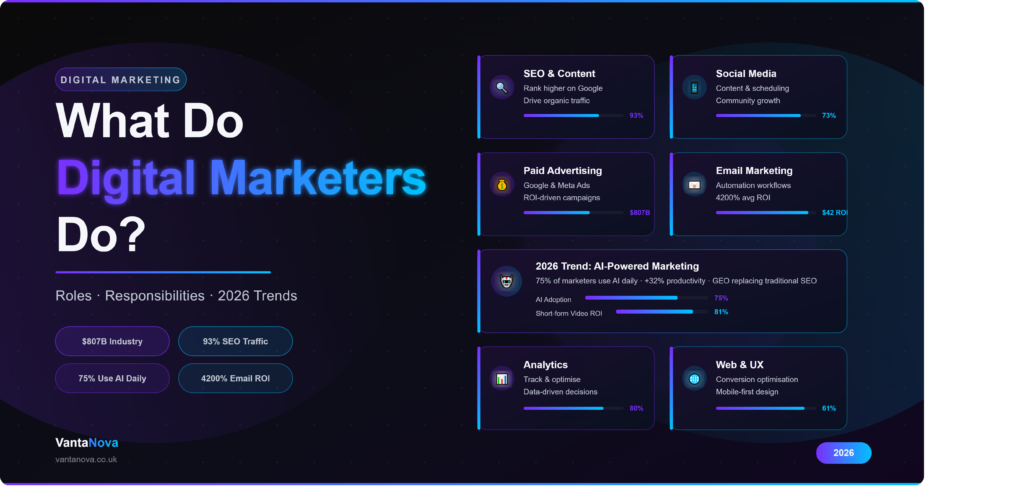
Digital marketing is one of the fastest-growing industries on the planet. The sector was worth $531 billion in 2022 and is projected to hit $807 billion by 2026 — making it one of the most valuable and in-demand professional fields in existence. But what does the work actually involve? Entrepreneurs HQ
Let’s break it down.
The Core Definition — What Is Digital Marketing?
Digital marketing is the practice of promoting products, services or brands through online channels — search engines, social media, email, websites, paid advertising and more. A digital marketer’s job is to attract the right audience, convert them into customers and retain them over time.
The discipline covers everything from writing a blog post to managing a £50,000 monthly paid advertising budget. It is as creative as it is analytical.
What Do Digital Marketers Actually Do Day-to-Day?
1. Search Engine Optimisation (SEO)
SEO specialists help websites rank higher on Google for terms potential customers are searching for. SEO remains the primary acquisition channel, driving 93% of all web traffic — making it one of the highest-leverage activities in any digital marketing strategy. Incremys
Day-to-day SEO tasks include:
- Keyword research and content planning
- Writing and optimising web page copy
- Building backlinks from other websites
- Fixing technical issues that prevent Google from crawling pages
- Tracking rankings and reporting on organic traffic growth
2. Content Marketing
Content marketers plan, create and distribute material — blog posts, videos, guides, podcasts, infographics — that attracts and educates a target audience. B2B brands consistently see their best returns from websites, blogs and SEO-driven content marketing, making content one of the most dependable long-term growth channels. Entrepreneurs HQ
3. Social Media Management
Social media managers create and publish content across platforms including Facebook, Instagram, LinkedIn and TikTok. They manage community engagement, run paid campaigns and track performance metrics. Short-form video is currently the most leveraged media format and delivers the highest reported ROI among all content types. Foursets
4. Paid Advertising (PPC)
Pay-per-click specialists run paid campaigns on Google Ads, Meta Ads and other platforms. They manage budgets, write ad copy, design landing pages and optimise campaigns for the lowest possible cost per conversion.
5. Email Marketing
Email marketers build lists, write sequences and manage automation workflows. Email marketing generates between $36 and $42 in ROI for every $1 spent — the highest return of any digital marketing channel. DemandSage
campaign Want results like these for your business?
Get a free, no-obligation audit — we'll show you exactly what to fix and what it's worth.
6. Analytics & Reporting
Every digital marketer, regardless of specialism, is responsible for measuring the impact of their work. Tools like Google Analytics 4, Search Console and platform-native dashboards are used daily to track what is working and optimise what is not.
Digital Marketer vs Traditional Marketer — Key Differences
| Factor | Digital Marketer | Traditional Marketer |
|---|---|---|
| Primary channels | Search, social, email, web | TV, print, radio, billboards |
| Targeting | Precise audience targeting | Broad demographic reach |
| Cost | Often lower, scalable | Higher upfront costs |
| Measurability | Real-time data and attribution | Difficult to measure directly |
| Speed | Campaigns live in hours | Weeks of production lead time |
| Feedback loop | Instant — optimise daily | Slow — results take months |
The Biggest Digital Marketing Trends in 2026
The industry is evolving rapidly. Here are the trends reshaping what digital marketers do right now:
AI-Powered Personalisation
75% of marketers now use AI daily, with 76% using it specifically to create content — delivering a 32% productivity gain. AI tools are being used to personalise email content, generate ad copy variations, automate reporting and identify ranking opportunities at scale. Incremys
Generative Engine Optimisation (GEO)
As AI-powered search tools like Google’s AI Overviews become mainstream, Generative Engine Optimisation — optimising content to appear in AI-generated answers — has become one of the defining new disciplines of 2026
73% of consumers now prefer a short-form video to learn about a product or service, and 92% of businesses consider video one of the most important parts of their digital strategy. FoursetsFoursets
Privacy-First Marketing
As third-party cookies disappear and data regulations tighten, digital marketers are shifting toward first-party data strategies — building email lists, loyalty programmes and owned audiences rather than relying on platform tracking.
Skills Every Digital Marketer Needs in 2026
- Copywriting — the ability to write clearly and persuasively for different audiences and formats
- Data literacy — reading and interpreting analytics to make evidence-based decisions
- SEO fundamentals — understanding how search engines work is relevant across every specialism
- AI tool proficiency — knowing how to use AI to accelerate output without sacrificing quality
- Strategic thinking — understanding how individual tactics connect to broader business goals
Frequently Asked Questions
Is digital marketing a good career in 2026?
Yes. Demand for marketing professionals is set to grow by 10% through 2026, and digital marketing roles consistently rank among the most in-demand skills globally. Salaries range from entry-level positions at £22,000 to senior specialists and agency directors earning well above £70,000. DemandSage
Do digital marketers need to be technical?
Not necessarily. While some roles — technical SEO, paid advertising, analytics — require a comfort with data and platforms, others like content marketing and social media management are primarily creative. Most digital marketers develop a mix of both over time.
What is the difference between a digital marketer and a social media manager?
A social media manager focuses exclusively on social platforms. A digital marketer typically has a broader remit — covering SEO, content, email, paid ads and strategy in addition to, or instead of, social media.
How long does it take to learn digital marketing?
The fundamentals can be learned in 3 to 6 months through online courses (Google Digital Garage, HubSpot Academy and Semrush Academy are all free). Becoming proficient enough to deliver real results for clients typically takes 12 to 18 months of practical experience.
Can small businesses do their own digital marketing?
Absolutely — and many do. However, most business owners find that the time investment required to do it well is better spent running the business. That is precisely why agencies like ours exist.
What tools do digital marketers use?
The most widely used tools include Google Analytics 4, Google Search Console, Semrush or Ahrefs for SEO, Canva for design, Mailchimp or Klaviyo for email, and Meta Business Suite for social media management.